
Bathroom Vanity Countertops Guide: Quartz vs. Marble vs. Granite (Stains, Double-Sink Spacing & Remnant Savings)
Written & Reviewed by AGS Stones Craftsmen
Master Stone Fabricators & Licensed Cabinet Contractors • Duluth, GA
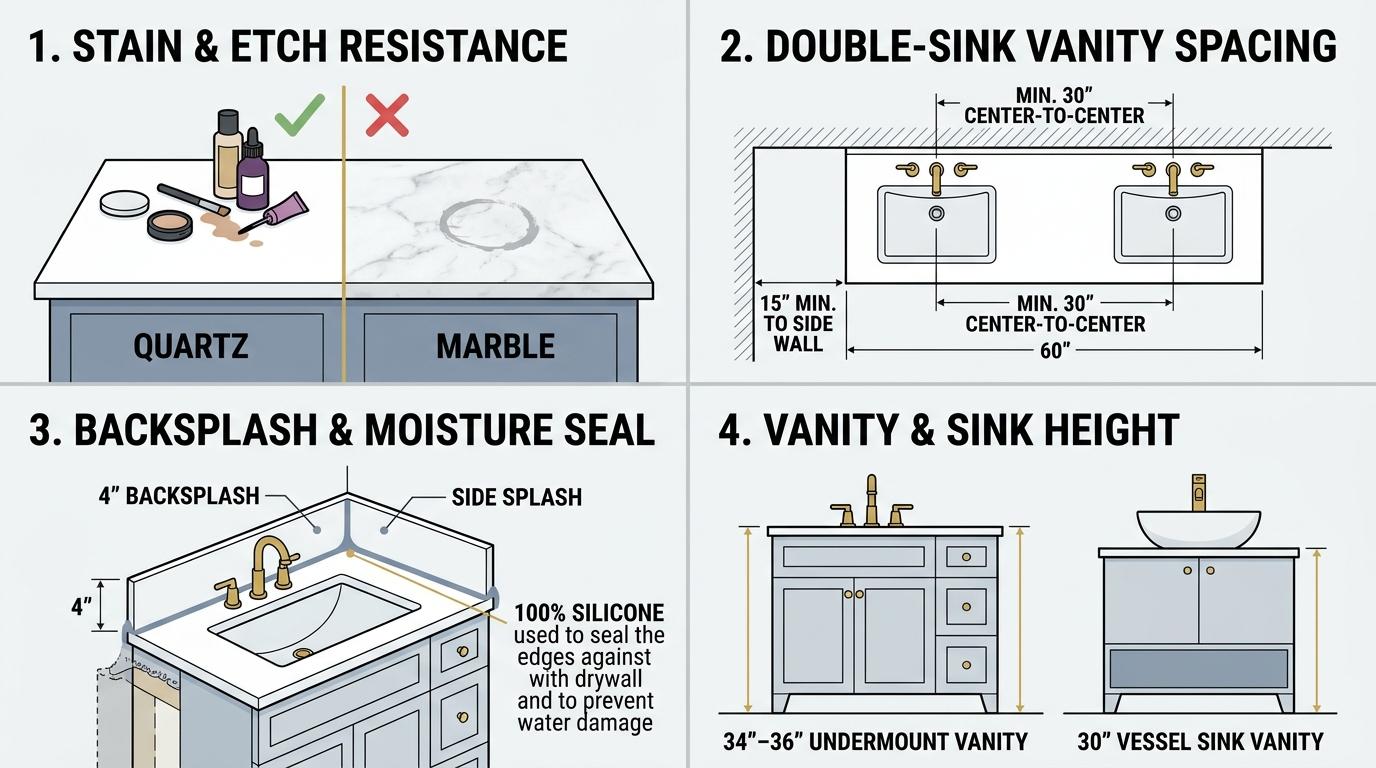
Key Takeaways: Quick Summary
- ✓Non-porous engineered quartz is the #1 bathroom vanity material for busy master baths: it resists foundation makeup, hair dye, whitening toothpaste, and acetone nail polish remover without requiring annual sealing.
- ✓Natural marble (like Carrara and Calacatta) offers timeless spa elegance for guest powder rooms, but its calcium carbonate composition chemically etches on contact with acidic skincare serums, citrus cleansers, and acetone.
- ✓Double-sink bathroom vanities (60" to 72" wide) require a minimum of 30 inches center-to-center between faucets and at least 15 inches from basin center to side walls so two adults can brush teeth comfortably.
- ✓Always install matching 4-inch stone backsplashes and side-splashes (where vanities touch alcove drywall) sealed with 100% mildew-resistant silicone to prevent bathroom water wicking and behind-the-wall mold.
- ✓Save 30% to 40% on small vanity tops (24" to 60") across Buckhead, Alpharetta, Milton, Johns Creek, Sandy Springs, and Marietta by hand-selecting full-thickness 3cm stone remnants directly from our Duluth slab yard.
Bathroom Vanity Countertops: Quartz vs. Marble, Spacing & Remnants
Bathroom countertops face a harsher chemical environment than kitchen islands. Every morning and night, vanity tops encounter boiling curling irons, foundation makeup, purple hair toner, acidic skincare serums, acetone nail polish remover, and standing soapy water. Whether you are updating a primary suite in Buckhead, a guest bath in Johns Creek, or a jack-and-jill kids' bathroom in Suwanee and East Cobb, choosing the right stone, spacing, and moisture seal makes all the difference.
⚡ Quick Rule of Thumb for Bathroom Remodels
- Primary & Kids' Bathrooms = Choose Quartz or Granite: Non-porous quartz shrugs off toothpaste, makeup, and hair products without etching or sealing, while granite shrugs off 450°F flat irons placed straight onto the counter.
- Powder Rooms = Safe Space for Real Marble: Guest half-baths rarely see hair dye, harsh chemicals, or standing water puddles—making them the ideal showcase for authentic Carrara or Calacatta marble elegance.
- Check Remnant Inventory Before Ordering Full Slabs: Most vanity tops under 72 inches wide can be cut from a discounted 3cm stone remnant at our Duluth yard, cutting material costs by 30% to 40%.
Bathroom Vanity Materials Compared: Quartz vs. Marble vs. Granite vs. Quartzite
Before selecting a slab for your bathroom remodeling project, compare how the 4 most popular vanity stones handle real daily toiletries and Metro Atlanta hard water:
| Bathroom Factor | 1. Engineered Quartz | 2. Natural Marble | 3. Natural Granite | 4. Natural Quartzite |
|---|---|---|---|---|
| Makeup, Hair Dye & Soap Stains | Virtually 100% stain-proof (non-porous resin matrix). | Absorbs oils, mascara, and hair toner quickly if sealer wears thin. | Highly stain-resistant when sealed annually. | High resistance when sealed every 12 months. |
| Acidic Etching (Serums & Cleaners) | Immune to toothpaste, facial acids, and soap scum. | Etches easily! Leaves dull white rings from bathroom cleaners. | Zero etching from household cosmetics or mild acids. | True quartzite does not etch like marble. |
| Hot Curling & Flat Irons | Use a silicone mat for 400°F+ irons to protect polymer resins. | Heat resistant, though thermal shock can stress veins. | 100% Heat-proof. Direct curling irons will not scorch. | 100% Heat-proof volcanic crystalline structure. |
| Sealing Maintenance | Never needs sealing. Zero upkeep. | Every 6 to 12 months required. | Every 12 to 24 months (or 15-yr AGS sealer). | Once per year with penetrating sealer. |
| Best Room Application | Master baths, kids' jack-and-jill baths, busy family homes. | Formal powder rooms, low-traffic guest suites. | Rental renovations, teen baths, classic estates. | Luxury Buckhead & Milton spa master suites. |
Method 1: Preventing Cosmetic Stains, Hair Dye & Etch Rings
One of the most frequent regrets homeowners in Sandy Springs and Roswell bring to our showroom happens when a builder installs unsealed Carrara marble in a master bathroom. Within months, a wet bottle of toner, mouthwash, or retinol serum leaves a permanent matte circle—called an acid etch.
✓ Why Non-Porous Quartz Wins Everyday Bathrooms
- Zero Porosity: Liquid foundation, mascara, and toothpaste sit strictly on top of the surface without seeping inside stone pores.
- True Marble Look without Anxiety: Modern Calacatta and Carrara-inspired quartz slabs mirror natural Italian veining without chemical vulnerability.
- Silicone Mat Pro Tip: Because quartz contains resin, always place a stylish silicone pad under heated hair straighteners or curling wands exceeding 350°F.
✗ Care Realities if You Choose Natural Marble
- Etching Is Not a Stain: Acidic toiletries actually dissolve a microscopic layer of calcium calcite. Sealer slows staining, but cannot stop acid etching.
- Honed vs. Polished Marble: If you adore genuine Italian marble for a powder room, choose a honed (matte) finish so minor etch marks blend in rather than dulling a mirror gloss.
- Avoid Abrasive Toilet & Tile Sprays: Overspray from standard shower cleaners will immediately cloud natural marble vanity decks.
Method 2: Double-Sink Vanity Spacing & Plumbing Clearances
Upgrading from a single bowl to a dual-sink vanity is the #1 request we receive for primary bathroom renovations across Alpharetta, Johns Creek, and East Cobb. However, squeezing two bowls onto too narrow a cabinet ruins elbow room and leaves zero space for soap or toothbrushes.
The 60-Inch Minimum Rule (and 72-Inch Ideal)
A double-sink vanity must be at least 60 inches wide. On a 60-inch cabinet, position each sink centerline 15 inches inward from the left and right outer edges—giving you exactly 30 inches center-to-center between faucets. If your bathroom alcove allows 72 inches, you gain a generous bank of center storage drawers between the bowls.
Standard 22-Inch Depth vs. Kitchen 25.5-Inch Depth
Kitchen cabinets measure 24 inches deep (25.5" countertop), whereas bathroom vanity cabinets measure 21 inches deep (finishing at a 22-inch stone countertop depth). Always confirm faucet spout reach and undermount oval vs. rectangular bowl depth so your faucet handles do not hit the 4-inch stone backsplash behind the sink.
8-Inch Widespread vs. Single-Hole Faucet Drilling
Our installation team core-drills faucet holes through 3cm vanity tops using diamond water-cooled bits right on site. Whether you prefer sleek single-hole waterfall faucets or classic 8-inch 3-piece widespread fixtures, have your physical faucets ready on installation day so spout spacing is guaranteed.
Method 3: 4-Inch Backsplashes, Side-Splashes & Mold Prevention
In minimalist kitchen designs, homeowners often skip the 4-inch stone backsplash in favor of full tile. In bathrooms, omitting splashes without full wall tile is a recipe for drywall rot:
💧 Waterproof Sealing Standards in Georgia Bathrooms
Always Include a Side-Splash Against Alcove Drywall
Whenever your vanity sits tucked against a side wall (such as beside a shower glass enclosure or corner wall), request a matching 4-inch stone side-splash. Turning on a faucet splashes water laterally onto drywall every single day; stone protects that drywall seam permanently.
100% Mildew-Resistant Silicone vs. Latex Caulk
Never allow painters or handymen to caulk the stone-to-backsplash seam with water-soluble painter's caulk. Painters' caulk cracks, turns yellow, and peels in steamy bathrooms. Our crews seal every vanity splash perimeter using 100% neutral-cure translucent or color-matched silicone.
Method 4: Undermount vs. Vessel Sinks — Get Your Vanity Height Right
Modern custom bathroom vanity cabinets are built at "Comfort Height" (34.5 to 36 inches finished countertop height), replacing outdated 30-inch 1980s builders-grade cabinets that force adults to stoop forward.
Undermount Porcelain Basin (34"–36" Deck)
The overwhelming favorite across Metro Atlanta homes. The porcelain basin mounts beneath your 3cm stone top, letting you wipe water drops directly from the stone into the drain with zero rim obstacles. Pairs ideally with comfort-height 34.5" cabinets for a clean 36" final surface height.
Above-Counter Vessel Bowl (29"–30" Deck)
Vessel bowls sit on top of the stone deck, adding 5 to 6 inches of vertical height. If you drop a vessel bowl onto a standard 36-inch vanity, the rim sits at an awkward 42 inches (chest height!). Always order a lowered 29-to-30-inch vanity cabinet when planning a vessel sink remodel.
Method 5: Save 30%–40% with Duluth Stone Remnants & Factory Pricing
Because AGS Stones fabricates dozens of full-size kitchen islands every week at our Duluth facility, our indoor yard houses hundreds of pristine full-thickness 3cm remnants in Calacatta quartz, Taj Mahal quartzite, and exotic granite—ideal for bathroom vanities, wet bars, and fireplace hearths.
Single Vanity (24"–48")
$450 – $950
Installed using factory-direct 3cm stone remnants including CNC undermount sink cutout, faucet drilling, and 4" backsplash.
Double Vanity (60"–72")
$950 – $1,850
Covers premium 3cm quartz or granite remnant, dual porcelain sink cutouts, 2 widespread faucet drillings, splashes, and laser install.
Custom Vanity + Stone Top
Save 20%–30%
Bundle all-plywood custom bathroom cabinetry with your stone vanity top and porcelain sinks under one unified AGS contract.
Method 6: Hand-Pick Your Vanity Stone Remnant in Duluth, GA
Homeowners from Buckhead, Alpharetta, Milton, Johns Creek, Sandy Springs, Roswell, and Marietta visit AGS Stones & Cabinets at 4579 Abbotts Bridge Rd Suite -10 in Duluth every day to walk our remnant yard in person:
Walk Our Remnant Racks
Tag your exact piece of Calacatta Gold quartz, Taj Mahal quartzite, or Carrara marble directly in our yard so you know the exact veining going into your bathroom.
Porcelain Undermount Sinks in Stock
Choose crisp rectangular or classic oval glazed white porcelain vanity basins right in our showroom—eliminating shipping delays.
5-Day Digital Laser Installation
Our Proliner laser crew templates your vanity walls for crooked corners and delivers your finished vanity deck and splashes in just 5 business days!
Ready to Upgrade Your Bathroom Vanity Countertops?
Visit our Duluth, GA showroom to browse discounted 3cm remnants or claim your free in-home digital laser estimate. Save up to 30–40% factory-direct on bathroom quartz, marble, granite, and custom vanities!
Serving the Greater Metro Atlanta Community
AGS Stones & Cabinets provides factory-direct fabrication, laser templating, and professional stone installation across all surrounding Georgia neighborhoods:
Common Questions from Homeowners
Is quartz or marble better for a master bathroom vanity countertop?+
For an everyday master bathroom, engineered quartz is significantly more practical than natural marble. Marble is composed of soft calcium carbonate that permanently etches (leaving dull cloudy rings) when exposed to hairspray, acidic Vitamin C skincare serums, mouthwash, or toilet bowl cleaners. Quartz delivers the exact same crisp white Carrara veining with zero etching and zero sealing required.
How wide does a bathroom vanity need to be for two sinks?+
The strict minimum width for a double-sink vanity is 60 inches (5 feet), though 72 inches is the gold standard for luxury primary suites in Alpharetta, Milton, and Buckhead. To meet residential comfort guidelines, sink drains and faucets should be spaced at least 30 inches center-to-center, with at least 15 inches of clearance from the sink center to any adjacent wall.
Can I save money on bathroom vanity tops using stone remnants?+
Yes! Because a typical bathroom vanity measures only 22 inches deep by 36 to 72 inches long (roughly 6 to 12 square feet), you do not need to buy a full 55-square-foot kitchen slab. At our Duluth fabrication facility, homeowners can hand-pick leftover 3cm quartz, quartzite, and granite remnants from major kitchen jobs, saving 30% to 40% while still receiving CNC cutting, undermount sink cutouts, and 5-day installation.
What is the ideal height for a bathroom vanity with an undermount sink vs. a vessel sink?+
Comfort-height vanities for standard undermount porcelain sinks finish at 34 to 36 inches tall (measured to the top of the stone). However, if you choose an above-counter vessel bowl sink (typically 5 to 6 inches tall), you must lower the cabinet and countertop deck height to 29 to 30 inches so the final rim stays comfortable for washing your hands.
Do I need a 4-inch backsplash and side-splash on a bathroom vanity?+
Yes, unless you are tiling the entire wall behind the vanity from floor to ceiling. A 4-inch stone backsplash—plus a matching 4-inch side-splash wherever the vanity sits flush against drywall—creates a watertight barrier sealed with 100% silicone. Without it, wet hand splashes soak into painted drywall, causing bubbling paint and black mold.
Ready to Experience the AGS Stones Difference?
Skip the retail middlemen. Visit our Duluth showroom to hand-select your exact full-size stone slabs, or schedule a free in-home digital laser templating estimate.
Explore Related Services & Local Guides
Core Fabrication Services
Local Service Hubs
Remodeling Guides
- → How to Clean and Seal Granite Countertops: The Step-by-Step Care Guide
- → Granite vs. Quartz: Which Stone Does Your Kitchen Actually Need?
- → How to Prepare Your Kitchen for Countertop Installation: The Ultimate Checklist
- → How to Clean & Care for Custom Cabinets: Keeping Finishes Like New
- → How to Measure Countertops for a Fast & Accurate Estimate: Step-by-Step
- → How Much Do Granite & Quartz Countertops Cost in Atlanta & Duluth, GA?
- → How to Choose the Best Countertop Edge Profile: Eased, Bullnose, Ogee & Waterfall Guide
- → How to Fix a Chip in Granite or Quartz Countertops: The DIY Repair Guide
- → How to Remove Stains from Quartz Countertops: The Complete wikiHow Guide
- → How to Match Countertops with Cabinets: The Complete Designer Guide
- → Quartzite vs. Quartz Countertops: The Complete Durability, Heat & Care Guide
- → Can You Put Hot Pans on Quartz Countertops? The WikiHow Heat Safety & Burn Repair Guide
- → Are Countertop Seams Normal? The Complete wikiHow Guide to Seam Placement, Hiding & Repair
- → How Far Can Countertops Overhang Without Support? The Complete wikiHow Island & Bar Bracket Guide
- → 2cm vs. 3cm Countertops: Which Thickness Should You Choose? (Plywood Subtop, Edge Profiles, Strength & Cost Guide)
- → Honed vs. Polished vs. Leathered Countertops: Which Stone Finish Is Best for Your Kitchen? (Texture, Cleaning, Fingerprints & Cost Guide)
- → Undermount vs. Farmhouse Sink with Quartz & Granite Countertops: The Complete Cutout, Reveal & Cabinet Support Guide
- → Waterfall Countertop Island Guide: How 45° Mitered Edges Work, Vein Cascading, Support & Costs
- → Full-Height Slab Backsplash vs. Tile: Quartz Behind Gas Stove Heat, Outlet Cutouts & Cost Guide
- → Best Countertops for Outdoor Kitchens: Granite vs. Quartzite vs. Quartz (UV Sunlight, Grill Cutouts & Georgia Climate)
- → Custom Cabinets vs. Stock vs. Semi-Custom: Plywood vs. MDF, Dovetail Joinery & Remodel Cost Guide
- ✦ Return to All Guides & How-Tos
Related How-To Guides
Continue learning with more step-by-step homeowner tutorials
How to Clean and Seal Granite Countertops: The Step-by-Step Care Guide
Step-by-step wikiHow-style guide to cleaning, sanitizing, and sealing natural granite. Master the water droplet test, remove stubborn water rings, and protect your stone factory-fresh.
Read Guide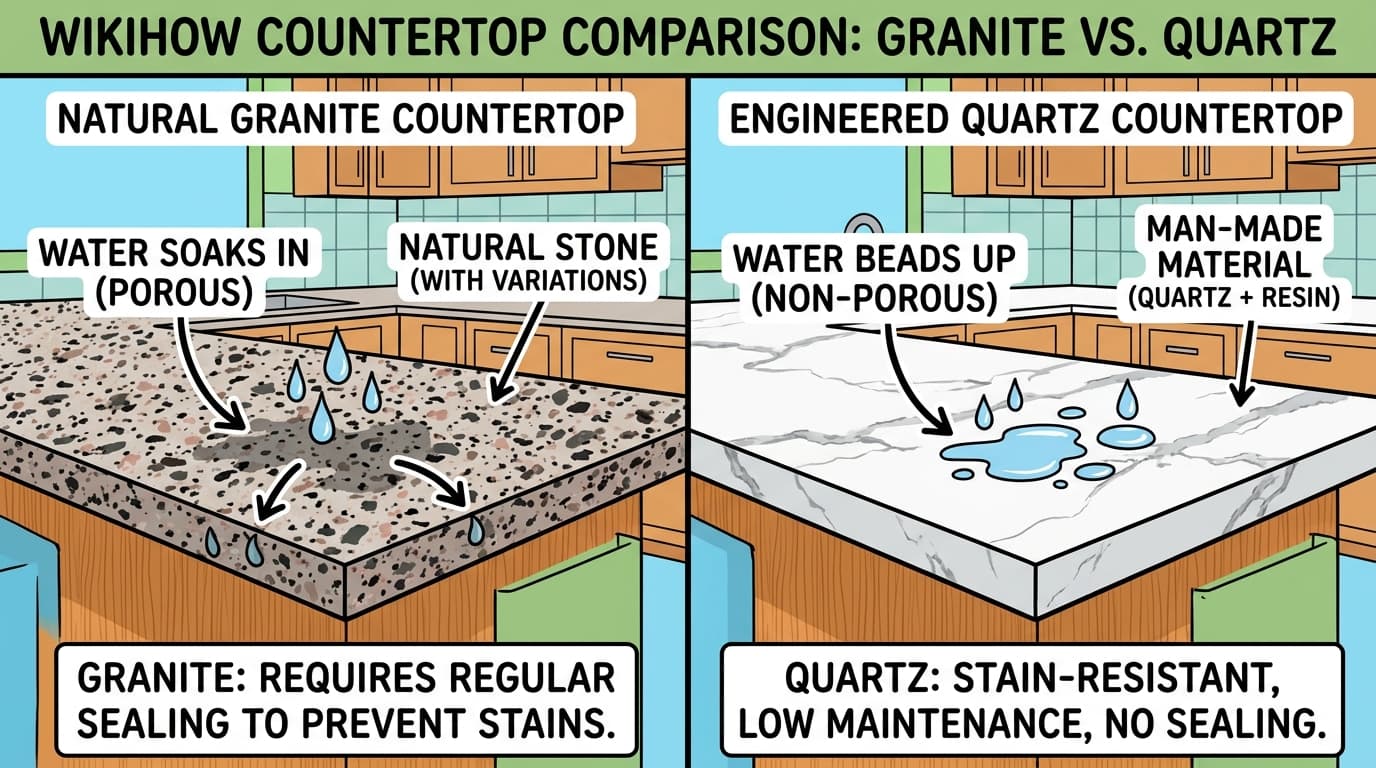
Granite vs. Quartz: Which Stone Does Your Kitchen Actually Need?
Confused between natural granite and engineered quartz? Learn the real differences in heat resistance, daily maintenance, seam visibility, and price per square foot.
Read Guide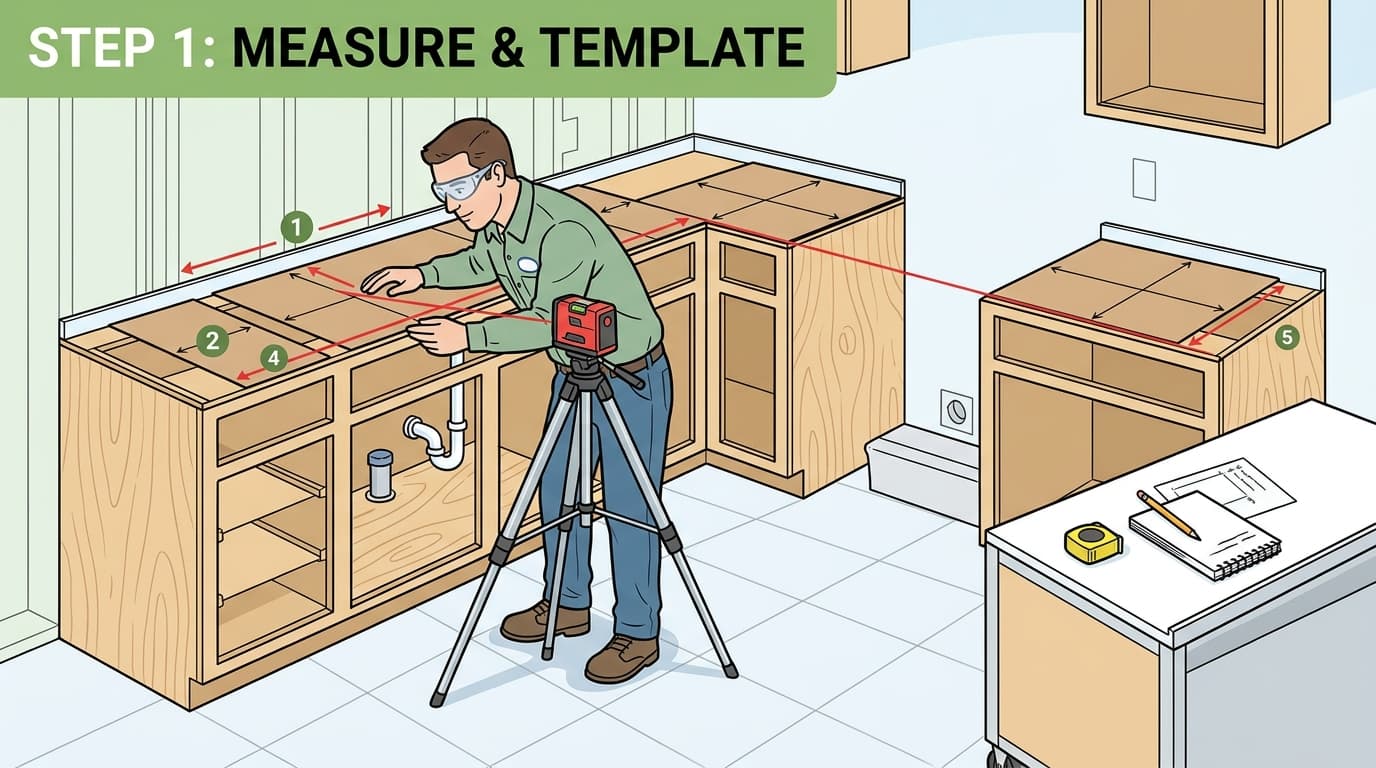
How to Prepare Your Kitchen for Countertop Installation: The Ultimate Checklist
Step-by-step preparation guide for laser templating and install day. Learn how to clear base cabinets, coordinate plumbers, disconnect sinks, and ensure a flawless fit.
Read Guide